We use cookies for performance, analytics and marketing. By using this site, you agree to our use of cookies. For more information, view our Cookie Notice and Privacy Policy.

20 Reasons NOT to Buy Sonlight
Will Sonlight be a good fit for your family?
Before you use Sonlight, it's good to know what you're getting into. Here are 20 of the most common reasons why Sonlight hasn't met the needs of some families and why parents opted against Sonlight altogether. Do you see yourself in any of these?
Your kids don't like reading.
Sonlight's programs are centered on books and reading. You'll read forty or so books in most Sonlight programs, so if you or your children don't like reading, Sonlight probably isn't going to be a good fit for family.
But even if your children don't like reading, be encouraged: for many families, the superb Sonlight books transform their reluctant readers into book lovers. Children and adults have become enthusiastic readers while using Sonlight. Our books are that good.
You prefer the idea of a computer-based program.
Overall, Sonlight's programs do require daily parental involvement. In the elementary and middle school years, parents are involved with almost all of their children's schooling. There is just so much invaluable discussion that we believe shouldn't be missed by leaving the teaching to an online program or instructor. With Sonlight, you get to offer your steadying hand and thoughtful input every single day.
In some Sonlight subjects, you can choose to supplement with a screen-based teacher. For example, in Math-U-See, Mr. Demme teaches the basics. In Science, you might choose to use the Discover and Do science experiment DVDs, instead of actually doing the experiments.
Your Instructor's Guide has done as much of the preparatory work for you as possible, so almost every minute of your time is spent in direct, face-to-face interaction with your children. Even so, Sonlight programs require about two hours a day of a parent's time, with less in the very early elementary years, a bit more in the middle elementary years, and then fewer hours again later on. High school varies from almost entirely independent work with no parental time, to an hour or so of purposeful discussion. It's up to you.
You can reduce the total time required for each level by skipping assignments or, if you have more than one child, by combining students. To educate your children the Sonlight way, you will need to invest time interacting with your children. But we like to think that's a perk, not a burden.
You prefer to focus more on academics than on character development.
At Sonlight, we believe that parents have a responsibility before God to help their children acquire wisdom, knowledge, and a foundation for future service. But Sonlight is also highly academic. A well-rounded liberal arts education in elementary, middle, and high school is valuable preparation for almost any post-high school pursuit. Graduates can choose a specialty in college, trade school, missions, the military, or the workforce.
Sonlight parents often share that their children's professors report that they are the best writers, the best thinkers, the most well-read, and the best-informed students in their classes. And students who come to Sonlight after a few years in classroom school regularly see their test scores rise substantially. (See the Sonlight scholarship winners, for just testimonies from a handful of gifted Sonlight students who graduated recently.)
But you don't have to wait until high school for stellar academics. In the elementary years, parents of younger students are astonished by how much their children are learning.
Sonlight is an excellent option, whether you choose it because of the academics, because of the lifestyle, the character instruction, or because you, yourself, simply love to learn. You will be with your children every day! There's plenty of opportunity for you all to grow in grace.
You like creating your own homeschool program.
Erika Evans wrote about her experience with this on the Sonlight blog.
It took me hours to collect ideas and organize materials. If one of the projects bombed with my kids or didn't work as planned, I felt I had wasted a ton of time and effort." But she hesitated to use a boxed curriculum because she feared "that it might sterilize our experience, that it might limit what we could learn and accomplish, that it might include too much busywork, that it would not allow for child-led learning, that it was a lazy mom cop-out which would lessen the home school experience for me and my children."
But what she found was that, with Sonlight, the reality was the exact opposite.
Having resources at the ready meant that we were always able to find interesting books to read and projects to do – right out of the box. There was always more material to cover and more ideas to discover. Not having to organize our entire day on my own meant that I was more available to the kids and actually had more time, not less, to help them explore their unique and individual interests.
"I found that reading them quality stories led them to ask more questions and become more invested in their learning. They wanted to know more about the topics we were covering and cared about the people and events in the books. Big box curriculum wasn't holding us back! It was giving us structure to zoom ahead in freedom!"
If you delight in researching and augmenting your children's homeschool, you can have the best of all possible worlds when you use Sonlight as a foundation and add to it. As Erika noted,
Having ready-to-go resources has truly made things easier, provided increased freedom, and improved the amount and quality of time I'm spending with my children."
In other words, as you build on Sonlight's basic structure, you have more freedom to create a homeschool program tailored to your family's needs.
You're hesitant to make such a large purchase without seeing the products firsthand.
If you can attend a homeschool convention near where you live, a veteran Sonlight mom will show you curriculum materials and answer your questions about the program. Click here for the listing of locations and dates.
But if you're unable to attend a convention, you can download the first three weeks of the Sonlight schedule from our website to get a general idea of what your lesson plans will look like.
And please remember that Sonlight backs your purchase with our 100% "Love to Learn, Love to Teach™" Guarantee. Take a full year to use half (18 weeks) of the program. If, at any time, you are unhappy with your History / Bible / Literature or All-Subjects Package in any way, simply return it, used books and all, for a complete refund of everything you paid.
And if you prefer to talk to someone, like you could in a bookstore or at a convention, our Advisors are available for a one-on-one conversation!
You prefer crisp, fact-based books, not stories that move you.
Sonlighters describe our books as poignant, heartwarming, powerful, deep, and thought-provoking.
Great books tell a story with emotional depth and develop an emotional connection between the characters and readers. Sonlight books are great; they create emotional connection. (Read Sarita's 7-point criteria for "Sonlight all-star" books.) But beyond that, from an educational perspective, when students connect emotionally with a story and its characters, they remember much more of what they have read.
Depth of emotion helps children develop moral imagination. As children begin to understand how the world looks and feels to others through stories, they develop the capacity to empathize with others and to understand how their actions affect the lives of others—far more than if they only understand intellectually that their actions have consequences.
This is why we include excellent books that teach us and move us.
You don't want to expose your extra sensitive child to natural disasters or other real-world experiences.
For most children, Sonlight books are age-appropriate. They are funny, poignant, exciting, and interesting books that deal with real-life in thoughtful and gentle ways. They are not meant to be shocking, aggressive, or inappropriate.
And yet our books do deal with real life.
If your children become upset if they hear about volcanoes or other natural disasters, or if the mention of the word "soldier" makes them cry, Sonlight might not be a good fit for your family.
Often, we find that children are eased gently into stories that help them process the world around them: the beauty and joy, and yes, sometimes pain, that is involved. But families may find that certain books need to be set aside for a season and picked up again later when their child is ready.
You want an Instructor's Guide to be a taskmaster, not a guide.
Your Sonlight IG is merely a schedule, a record, not a standard to hold yourself to. Because the Sonlight Instructor's Guide is just that...a guide, it is not a taskmaster. Here are some examples of how families may elect to use Sonlight:
- Most parents pick and choose from the suggested assignments. Even if they read most of the books, they might ignore some comprehension questions or skip some writing assignments.
- Some families skip the timeline figures during the school year and instead elect to spend a few hours at the end of the school year assembling their timeline all at once as a year-end review.
- Some parents allow their children to drop two Readers a year, so their children only read fifteen or so books.
- In the early years, some families elect to use the Discover & Do DVDs in lieu of doing the experiments.
- Some choose to do Read-Alouds at night, as bedtime stories. Or they might save some of the Read-Alouds for the summer when their children are bored.
And the beauty is...ALL the families described above are giving their children a terrific education.
You want your children to follow the same sequence as your local school district.
In the early grades, you can be assured that students in one school will learn things that their peers in another school have not. Different curricula may follow their own sequence. But notice the qualifier: in the early grades.
Over time, those sequential differences disappear. In fact, because Sonlighters learn so much and become such eager learners, eventually, you are likely to tell a story similar to one shared by Christy H. of Galena, MO, who sometimes worried that her children weren't learning enough.
When my kids randomly bring school into conversations with others—for example, when my 8-year-old discusses ancient Egypt and Rome with my cousin who is a history major in college, or when my 6-year-old explains to her fisherman grandpa why his boat floats—then I know we're doing okay!
With a Sonlight education, your children will not merely absorb basic information, but, far more, they'll develop an inquisitive spirit and love for learning. When you consider the quantity and wide range of books and characters your children will meet in Sonlight, it's no wonder they can readily engage with people on an astonishing variety of topics.
With Sonlight, you set the stage for students to continue learning even after they have completed their formal education. Later, they will pick up information they may have missed during their school years, not because they have to, but because they want to.
You want your children to lead their own course of study.
Sonlight Curriculum is structured—especially from Sonlight D on. However, although the Instructor's Guides plot a course of study, families are not required to do precisely what the guide suggests. Sonlight Instructor's Guides are designed so you can readily modify the program.
For example, we have heard from unschoolers who appreciate the foundational structure that Sonlight offers. That structure gives them confidence to launch out on their own beyond what's in the Instructor's Guide. They successfully weave their free-form program around the Sonlight base.
So, if you love the idea of lots of literature but want the freedom to modify a program to fit your family's preferences, Sonlight may be exactly what you're looking for!
You want Scripture on every page of your children's curriculum.
Sonlight academics are based on, and intentionally related to, Scripture. Bible reading, Christian teaching, and memory verses are an integral part of every Sonlight HBL program. In Level G through high school, rigorous Bible study (including apologetics and Church history) is woven into the program. But not every page in the IGs has a Scripture quotation.
When a passage of Scripture provides insight or understanding to a subject, the IG will often mention it. But in general, the Sonlight approach is to provide rich materials that help you engage in more natural conversations about Scripture with your children.
For example, when you read The Hundred Dresses in Sonlight A, the story itself presents wonderful opportunities to discuss Biblical principles in real-life settings with questions like, "Why should we care for others?," "What does kindness look like?," or "How do we stand up for what is right?" Instead of teaching a specific Bible lesson, Sonlight allows you to consider your children's unique needs and teach the specific character principle you want to focus on.
If you wonder whether the Christian parts of Sonlight will meet your expectations, please download the free three-week samples of the Instructor's Guides from our website to get an idea of how we incorporate God and scripture into our curriculum.
You don't want to own books that assume evolution.
Some books in Sonlight's History and Science programs assume an evolutionary/old-earth perspective. However, when a book has evolutionary content, the IG offers notes so you can discuss the different perspectives on the beginning of the universe with your children.
If you would rather not own books that assume evolution, Sonlight will not be a good fit for you.
You want a religiously neutral program.
Most Sonlight books—ninety percent or more—are non-religious. However, the Sonlight Instructor's Guides (IGs) are not religiously neutral.
The Instructor Guides were intentionally written from a biblical, evangelical Christian perspective. They hold the position that the Bible is the Word of God and speaks to the issues of today. Since Biblical content is woven into most Sonlight courses, even if you don't include Sonlight's Bible program in your coursework, Sonlight does not provide a religiously neutral curriculum, nor will you avoid all references to God, the Bible, or Christianity.
You want to study American History every year.
Western culture—and American society within the last 150 years in particular—has enriched the world in many ways. With Sonlight, you'll learn about America's unique contributions with four solid years of U.S. history and culture.
But Sonlight also devotes eight years to the rest of the world, including not only Western history and culture, but the cultures and histories of Asia, Africa, the Middle East, and indigenous peoples elsewhere around the world. With Sonlight, your children are prepared to think about, pray for, and serve Americans, but also peoples and cultures around the world—wherever God may lead them.
We live in an increasingly globalized world. As international commerce increases, there are many practical reasons for children to study cultures and peoples beyond America's borders, offering them the knowledge and capacity to transcend national boundaries.
See Sonlight's complete Scope and Sequence.
You don't want your teacher's notes to come from American conservative Christians.
Primary Sonlight developers, John and Sarita Holzmann, are evangelical Christian, middle-class Americans. Born and raised in the United States, they are the children of first-and second-generation European immigrants. As John says,
We are grateful to God and to our parents for the heritage we enjoy. Yet we recognize that our backgrounds mean our perspectives are limited, though we seek to be as sensitive as possible to those from other backgrounds.
"If you are looking for a broad-based, internationally-focused curriculum that is deeply committed to looking at issues from ‘all sides,' and if you can overlook some of our (usually unwitting) American provincialisms, we expect we can provide the kind of educational program you are looking for."
John and Sarita have attended a wide range of Bible-believing churches over the years, and do not push a particular Christian denomination or theology in the development of the Sonlight programs.
Sonlight is delighted to serve people who live in over 150 different countries and who come from Catholic, Seventh Day Adventist, Mormon, Muslim, Jewish, and other religious persuasions. But please realize up front—Sonlight's developers do come from a particular perspective that may not align with every family's perspective or world view.
You prefer frequent, written tests.
From its foundation, Sonlight was designed to capitalize on the efficient, tutorial environment of the home.
Because you're in daily, personal, one-on-one contact with your students (unlike the relationship that exists between most classroom teachers and their students), you'll be able to evaluate the progress of your students through means other than quizzes, tests and gradable worksheets.
When you're reading a book, you'll likely discuss it with your children with questions like "Why do you think he wanted to do that?" or "What does ____ mean?" As your children answer your questions, you will be able to determine exactly how much they have understood (or not understood) from the reading. Such methods for gauging progress should provide you with the feedback you need to be confident in your children's day-to-day progress.
But what if your children need to transfer to a classroom, or need to take the SAT or ACT in anticipation of attending college?
- Some Math programs, and all the Apologia Science programs, include tests. When you anticipate a transition, you can give your children practice with these kinds of tests.
- Depending on where you live, your state may require annual or intermittent standardized testing. But whether testing is required or not, administering standardized tests on an occasional basis has some benefits! They can help you know if your kids are missing key skills or subject matter. Standardized tests provide children with valuable test-taking practice. They can also help you determine where you may want to beef up your teaching and may actually encourage you with the knowledge of how well you are doing! (Sarita herself discovered the benefits of testing her children. She assumed that since she taught her children to read using phonics, that spelling would make sense, and they would be good spellers. It wasn't until she had her children take a standardized test that she discovered, "Oops! I need to teach spelling.")
Regarding tests and measuring progress, homeschooling doesn't have to be just like a "traditional" school...unless you want it to be.
You want hands-on activities every day.
Sonlight includes hands-on activities, but hands-on has never been our emphasis. We believe the educational value of many activities often isn't worth the hours of preparation that parents must complete. So, more often than not, we encourage you to allow your children to decide for themselves what activities they want to do as they read about new places and people. A box, after all, can become a time machine, a cave, an airplane, or a house.
You'll find suggestions for hands-on activities and experiments in the Sonlight Science Guides. Some books include craft suggestions, and some math programs incorporate hands-on manipulatives into their lessons. And, finally, we have optional hands-on history projects available that complement some of our History / Bible / Literature levels.
You want to teach with worksheets.
"My son just does his work and can get on with his day!"
Worksheets are so appealing, aren't they? It's just so much easier to solve a basic Math equation than to solve a word problem, right? That's because, with word problems, you actually have to apply what you've learned to something...more like the real world. And that usually takes more effort and thought.
So, too, with education.
A Sonlight education deals with real-life, practical things that take time and effort to think and talk through. For example, when you read the Gospel of Luke with your children, they'll hear Jesus say some really unexpected things...like the story of the man who commended the dishonest manager or the worker who hid his money and gave it to the man who had already multiplied his. It will take time to work through what Jesus meant in these parables. That's not as easy as answering a simple question, like "Who was Jesus?" with "the God the Son." But it is meaningful...and more worthwhile!
Worksheet-loving children can enjoy Sonlight's Language Arts and Science worksheets or additional worksheets available for Math, Vocabulary, Grammar, and Handwriting. With a Sonlight education, you can get in plenty of worksheets. Just not in History, Literature, or Bible, where the depth and breadth of the information requires more discussion and thought.
You want to teach all your children the same materials, no matter their ages.
The claim that you can cover the same material with all your children at one time, no matter their age, is very enticing. It makes sense that you'd want to do everything together. But there might be more to consider.
First, while it is true that great literature appeals to a span of ages, you can only take that so far. Few kindergarten or first-grade students will grasp books whose content is designed to challenge their fifth or sixth-grade siblings (let alone high school students). Even beyond basic comprehension, there is the issue of maturity. At a certain point, the range becomes too great. You will inevitably find that you are either overwhelming your younger children, not challenging your older students, or both!
So what has Sonlight done to help parents teach multiple students? You'll find age-appropriate programs for Preschool through High School that, because of their literature base, can be combined for children aged within about three years of each other. You can use one Sonlight History / Bible / Literature program and one Sonlight Science program for all of them, with skill-based subjects like Math, Language Arts, and Reading selected for each child's age or level. This allows you to keep Sonlight's broad international focus, the great literature base, and the depth of discussions while moving everyone forward at appropriate levels. When the age ranges diverge more widely, children should be separated into smaller study groups.
In summary: if your children are spaced more than about three years apart, consider whether it might be counterproductive to teach them together. Read more about how to teach multiple students.
You want a four-year, chronological cycle of history.
Many homeschoolers like the idea of teaching world history in a four-year cycle, repeated three times over the course of twelve years. It makes sense that History should be taught in chronological order, and it takes about four years to adequately cover history from creation to the modern era.
Every Sonlight History / Bible / Literature package emphasizes Geography and incorporates timeline activities. This ensures that your students will understand the flow of history. They will also understand where things happened, among which peoples they occurred, and, most importantly, why. But rather than following a consistent four-year cycle three times over, Sonlight breaks the pattern by including additional focus on certain places, eras, and types of history that a regular four-year cycle might skip.
In addition to studying World History over a two-year period in both the early elementary and middle school years, you'll study:
- a total of three focused years on American History
- a one-year intensive course on the history of the Christian church
- 20th century World History, an important century for developing an understanding of today's world
- a year spent on the Eastern Hemisphere, learning about the cultures and practices of the majority of people on earth
- a year covering a set of common prerequisites for college: studies in Civil Government and Economics
But wait! Do these breaks in the chronological study confuse children? No. We've found that just like a properly filled in back-story only helps a narrative, so too, your students' understanding is enhanced when they see and discuss the parallels and contrasts between peoples, cultures, and events of other times and other places.
Chronology is important, but it is not paramount. There are compelling reasons to take time focusing on additional studies.
While there are real reasons why you might decide that Sonlight is not a good option for your family, there are also many good reasons why it might be the best decision you make this year.
We are with you every step of the way: from helping you determine your school plan, to encouragement and prayer throughout the year. If you need assistance, contact a Sonlight Advisor.
But whatever program you choose, we at Sonlight pray God's blessing on you as you search for the best homeschooling materials for your family.
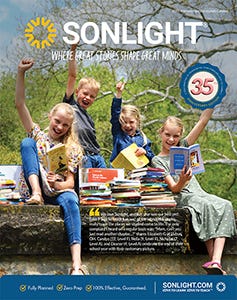
REQUEST A FREE CATALOG
Find your ideal homeschool curriculum in the pages of Sonlight's free catalog. Browse Sonlight's award-winning literature-based curriculum and academically excellent products in all subjects—for all grades.