Sonlight Reading Level Test: Free Reading Placement Tests for Kids
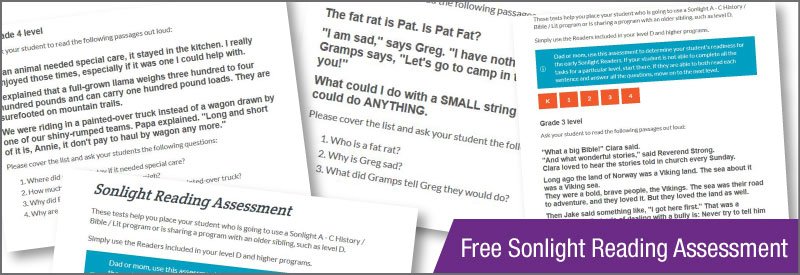
Instructions
In the lower elementary grades, students learn to read at different rates. Use this reading placement test to determine your student's reading comprehension and readiness for the early Sonlight Readers.
- Select your child's grade level.
- If your student is not able to complete all the tasks for a particular reading level, start at that level.
- If they are able to read each sentence and answer all the questions on the reading placement test, move on to the next level.
Grade K Reading Level Test
Ask your student to read the following out loud:
Pam bats.
Jim has a ham.
Ben's dog digs.
Meg has bug pets.
Please cover the list and ask your student the following questions:
1. Who has a ham?
2. What does Ben's dog do?
3. Who has bug pets?
Grade 1 Reading Level Test
Ask your student to read the following out loud:
The fat rat is Pat. Is Pat Fat?
"I am sad," says Greg. "I have nothing to do."
Gramps says, "Let's go to camp in the hills. That will be fun for you!"
What could I do with a SMALL string ball? With a BIG ball of string I could do ANYTHING.
Please cover the list and ask your student the following questions:
1. Who is a fat rat?
2. Why is Greg sad?
3. What did Gramps tell Greg they would do?
Grade 2 Reading Level Test
Ask your student to read the following out loud:
Next, God rolled back the waters and some dry ground appeared. God put a shining sun in the sky for daytime.
The father saw his son coming down the road. "My son was lost, but now he's found."
It is April 10, 1912. The whole world is talking about an amazing new ship. Its name is the Titanic.
Please cover the list and ask your student the following questions:
1. What did God put in the sky for daytime?
2. What happened when God rolled back the waters?
3. What is the name of the amazing new ship the whole world is talking about?
Grade 3 Reading Level Test
Ask your student to read the following out loud:
"What a big Bible!" Clara said. Long ago the land of Norway was a Viking land. The sea about it was a Viking sea.
They were a bold, brave people, the Vikings. The sea was their road to adventure, and they loved it. But they loved the land as well.
Then Jake said something like, "I got here first." That was a mistake. The first rule of dealing with a bully is: Never try to tell him why he's wrong. Bullies don't like that.
"And what wonderful stories," said Reverend Strong.
Clara loved to hear the stories told in church every Sunday.
Please cover the list and ask your student the following questions:
1. What did Clara like to do when she went to church every Sunday?
2. What did Jake say to the bully?
3. Who were the people who lived in Norway long ago?
4. What is the first rule of dealing with a bully?
Grade 4 Reading Level Test
Ask your student to read the following sentences out loud:
If an animal needed special care, it stayed in the kitchen. I really enjoyed those times, especially if it was one I could help with.
I explained that a full-grown llama weighs three hundred to four hundred pounds and can carry one hundred pound loads. They are surefooted on mountain trails.
We were riding in a painted-over truck instead of a wagon drawn by one of our shiny-rumped teams. Papa explained. "Long and short of it is, Annie, it don't pay to haul by wagon any more."
Please cover the list and ask your student the following questions:
1. Where did an animal stay if it needed special care?
2. How much does a full-grown llama weigh?
3. Why did Papa say he and Annie were riding in a painted-over truck?
4. Why are llamas a good animal for carrying heavy weights?

REQUEST A FREE CATALOG
Find your ideal homeschool curriculum in the pages of Sonlight's free catalog. Browse Sonlight's award-winning literature-based curriculum and academically excellent products in all subjects—for all grades.