Overview
According to its developer, a registered occupational therapist, Handwriting Without Tears is the only developmentally-based handwriting program on the market today. That means it pays attention, in a way that no other program we know does, to the developmental needs of people-of whatever age-who are trying to learn how to write.
Scroll down to learn more...
2013 edition
We recommend this program for students ready to begin handwriting and include this in the Grade K Multi-Subject Package.
Retail: $76.22
Core: $68.60
Item #HWK
2013 edition
Developed by a registered occupational therapist, Handwriting Without Tears is a developmentally-based handwriting program.
Retail: $21.49
Core: $19.34
Item #HW1
2013 edition
This program is a complete review of numbers, capitals, and lowercase letters. It is included in the Grade 2 Multi-Subject Package.
Retail: $18.74
Core: $16.87
Item #HW2
2013 edition
Included in the Grade 3 Multi-Subject Package.
Retail: $21.49
Core: $19.34
Item #HW3
2013 edition
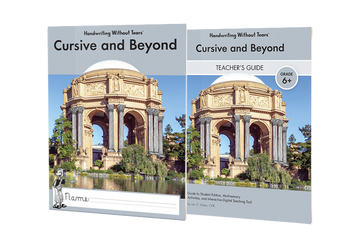
Help your students polish their cursive writing.
Retail: $18.74
Core: $16.87
Item #HW4
Can-Do Cursive is for students still mastering cursive.
Retail: $12.25
Core: $11.03
Item #HW5
(approx. 5th grade)
Retail: $12.25
Core: $11.03
Item #5L172
Can-Do Cursive is for students still mastering cursive. With cursive review and ideas for extra practice.
Handwriting Without Tears
Retail: $13.99
Core: $12.59
Item #KL177
The Capital Letter Cards are ideal for children who are just learning capital letters.
2013 edition
Retail: $13.75
Core: $12.38
Item #2L171
Multisensory lessons help you teach to your children's learning styles. Plans outlined by day and week keep you on track. You'll also introduce students to cursive writing near the end of this program...
2013 edition
Retail: $13.75
Core: $12.38
Item #4L171
Use this guide with the 4th grade student workbook
Cursive Success
Retail: $38.00
Core: $34.20
Item #KL175
Three-dimensional shapes are integral to the Handwriting Without Tears Readiness Program.
Retail: $29.99
Core: $26.99
Item #PL03
This guide is intended for use with the Get Set for School® Pre-K workbook.
2013 edition
Retail: $12.25
Core: $11.03
Item #3L192
Consumable workbook.
2013 edition
Retail: $12.25
Core: $11.03
Item #4L172
Consumable. Approximately 4th Grade.
2013 edition
Retail: $11.49
Core: $10.34
Item #3L191
Required Resource for using the Cursive Handwriting student workbook. Young writers learn the basic connections used in cursive writing.
My First School Book
Retail: $12.25
Core: $11.03
Item #PL04
Get Set for School® is a "crayon only" workbook for four- to six-year-olds at a Pre-K level. It uses a developmental sequence for shapes, pre-strokes, letters and numbers.
2013 edition
Retail: $12.25
Core: $11.03
Item #KL172
Uses multisensory approach to teach correct capital and lowercase letter placement and formation, correct number formation, consistent printing habits.
Retail: $7.49
Core: $6.74
Item #KL176
Foam mat, similar to a mousepad, for laying out the capital letter wood pieces (KL175).
2013 edition
Retail: $12.25
Core: $11.03
Item #1L172
Consumable workbook. Designed to eliminate problems with reversals, spacing, placement, and letter and numeral formation. Letters are used in simple words and sentences to ensure continuous review. Ap...
2013 edition
Retail: $12.25
Core: $11.03
Item #2L172
Consumable workbook. A complete review of numbers, capitals and lowercase letters. Students write words, sentences, and simple paragraphs. Emphasizes fluency rather than repetitive copying. Approx. 2n...
2013 edition
Retail: $13.75
Core: $12.38
Item #1L171
Includes specific, multi-sensory instructions for the My Printing Book student workbook.
2013 edition
Retail: $13.75
Core: $12.38
Item #KL171
Provides an overview of the Handwriting Without Tears curriculum, explains the philosophy and gives the developmental rationale for its approach. Includes specific instructions for all readiness (pre-...
Retail: $11.99
Core: $10.79
Item #KL173
5" x 7" slate for printing letters and numbers.
Learn More
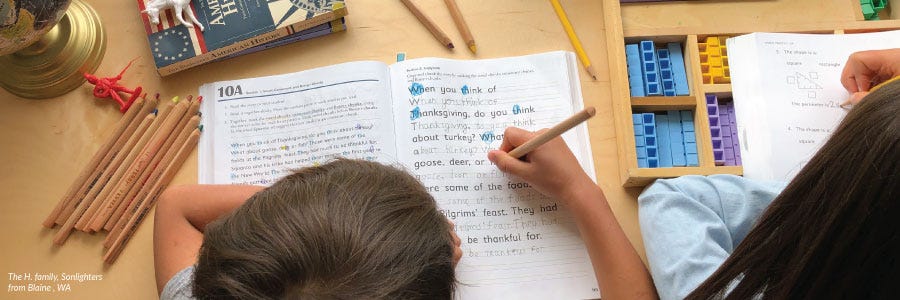
Most of us don't think of these skills, but consider: good handwriting requires the ability regularly to distinguish certain shapes and to translate those distinct mental images into consistent physical motions in one's hand. It requires the ability to hold a writing instrument in a comfortable manner. It requires the writer to consistently follow certain well-defined, pre-prescribed motions....(There are more skills, but I just want to give you a taste.)
In keeping with its developmental concerns, Handwriting Without Tears offers extremely basic exercises in figure-ground discrimination and top-to-bottom, left-to-right sequencing. When it comes to forming letters, it begins with all the capitals.
(Why? Because, unlike, say, the lower-case p, q, b, and d, the capital letters are all very easy to distinguish. Kids don't mix them up. P, Q, B and D all look very different. Moreover, the capital letters are all constructed of only four distinct shapes, all four of which are relatively easy to write.)
Handwriting Without Tears uses a unique (in the United States) two- rather than three-line writing paper. (The author says that beginning writers who are taught using three-line paper often lose track of which lines they are supposed to be aiming for-and so their writing will often move (up and down) between, over and across the various lines. The two lines, by contrast, are easily distinguished, and each two-line pair is strongly separated from the next.)
Handwriting Without Tears has been wonderful! Both of my kids love it. The methods are engaging, easy to remember, and they help kids form neater letters. The very first day, with just the 2-line paper, my son's writing improved (I was surprised!). And, my children's writing doesn't look like Handwriting Without Tears, it looks like their own version. I got My Printing Book for both of them so I haven't used any of the other books yet. You can always change to a "prettier" style if you have a child who wants to put the time and artistry into making beautiful letters. But for methods — hands down, Handwriting Without Tears is the best.
— Merry, 17 May 2005
Note: If you choose the Handwriting Without Tears program, you will notice that they introduce letters in a different order than we do in the Instructor's Guide. This is on purpose since the handwriting program starts with the letters that are the easiest to write and progresses to those that are formed similarly.
When teaching letter sounds, we are preparing your child for reading. What is important to learn first for reading is not necessarily the easiest to learn to write.
Some of the potential advantages of Handwriting Without Tears:
- It works. Even with kids who face significant learning challenges and physical limitations. (If you're a member of the Sonlighters Club, go to Special Needs-Learning Challenges Forum to talk with some unbelievably pleased moms!)
- You'll find that it makes sense to you as you are trying to teach.
- Users say it's particularly easy to use with left-handed students.
Primary potential disadvantage:
- Letter forms are slightly modified from the "traditional." Print characters tend to be narrow, with long ascenders and descenders (the lines that go above the "middle" line and below the "bottom" line on traditional, three-line writing paper). Cursive letters are formed in a completely upright rather than slanted position. These modified letters may appear unattractive to people who have been trained more conventionally.