

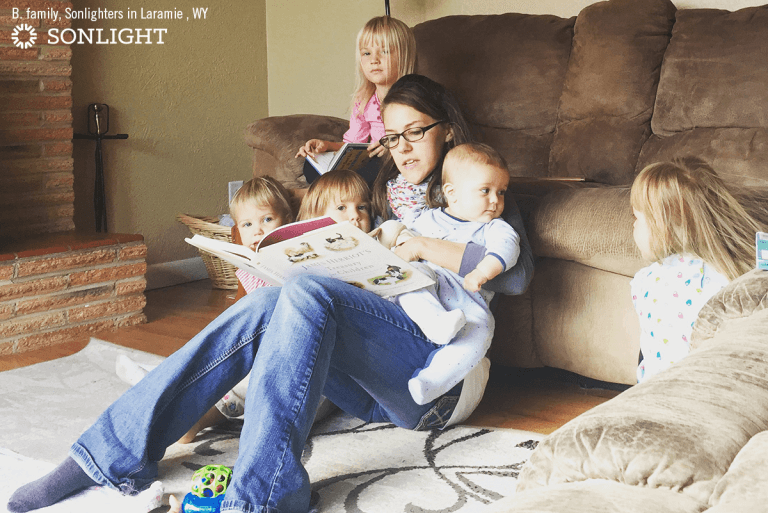
My whole crew was sick with walking pneumonia and journeyed en masse to the doctor’s office. At the appointment, my six-year-old daughter and four-year-old son collectively informed the nurse that they felt feverish, fatigued, and as if they must gasp for breath. My two-and-half-year-old added that we were miserable.
By way of explanation to the somewhat surprised doctor, I laughed and said, “We read a lot!”
As a Sonlight family, our kids use words that surprise others. Sometimes they even surprise us with their advanced vocabulary and complex grammar! I attribute their beyond-their-years communication skills directly to our habit of reading aloud.
Reading aloud has loads of benefits for speech acquisition and communication in general. Yes, it enables our kids to use an expansive and descriptive vocabulary to wow doctors, mail carriers, and the unsuspecting check-out lady at the grocery store. More importantly though, reading aloud develops language skills that empower our kids to communicate with others and make sense of the world. Here five ways I have witnessed Read-Alouds benefit my children's oral communication skills.
1. Exposure to a Diverse Vocabulary
The bulk of a child’s vocabulary is formed by the words they overhear at home. Thanks to reading aloud our Sonlight books, our kids know and use words that we might not typically use in conversation.
Just yesterday my daughter yelled, “Look, Grandma is emerging from the car.” This is not a sentence I have ever uttered. By reading aloud, she’s been exposed to the word emerging often enough to feel comfortable using it in her own speech.
Great literature makes a great vocabulary doable by providing pronunciation, articulation, and phonetic awareness. Children need to hear words in context multiple times before they can use them themselves. Reading great books to your children makes vocabulary development painless.
2. Using Words in Appropriate Context
Instead of prodding them to recite spelling and vocabulary words, I see my children voluntarily using new words throughout the day. This is especially true in their pretend play. For example, our homeschool study of Greek mythology has sparked weeks of imaginative play. I hear them shouting, “Watch out, Bellerophon! Pegasus is descending from the sky!” This is shouted as my sons encircle my laughing daughter, pretend wings flapping. The kids retell the stories using colorful and wonderful language in an appropriate context—words they gleaned from Read-Alouds.
3. Building a Large General Knowledge Bank
One Sunday we arrived at church to find the entire front field covered in yellow dandelions. My son proclaimed, “It’s a flock of dandelions!” Although the noun flock is typically reserved for animals or humans, you can absolutely derive his meaning. And in my opinion, his use of the word was delightful!
From an early age, kids gather an immense amount of information about the world around them from stories. As they are introduced to new vocabulary or the new application of a familiar word, they pull examples from that general knowledge. Literature fosters an ability to draw parallels and comparisons between the known and unknown.
4. Developing an Ear For Grammar
Ever cringe when someone says something like more better? Me too. More importantly, so do my kids. Someone uttered this nails-on-chalkboard phrase at a recent dinner. My daughter turned to me with a frown line between her brows and a squished up nose. “Mom,” she said, “that just doesn’t sound right.”
Even though we haven’t started any formal grammar study, she knew something was off with the phrase more better. Kids with vast exposure to language will know when something just doesn’t sound the way it should. We’re building amateur proofreaders simply by reading aloud! Kids internalize what they are exposed to and build an inner grammar compass against which to evaluate what they hear, what they say, and eventually what they compose when they begin writing.
5. Inspiring Curiosity and Desire to Use Language Correctly
“Mom, what does it mean to comb the beach?”
I had to laugh. Reading the story it hadn’t even occurred to me that comb would be a novel word for them. Now, we are combing everything:
- the backyard for flowers
- their bedrooms for lost items
- the refrigerator for a snack
My kids ask what a word means at least once a day. I love it! It’s almost always a word they hear in a Read-Aloud and want to understand and use it correctly. Read-Alouds inspire them to think about language in a way that they likely wouldn't otherwise.
Our family connects with each other over stories. Since our kids are used to us reading aloud, exploring language is relaxed and fun. Our kids are comfortable asking for the meaning of words and using them in their oral communication. Sonlight’s great selection of literature is a blessing for the language development in our homeschool.

Switch to a curriculum that builds communication skills the easy way—by reading aloud. Try three weeks of any Sonlight Instructor's Guide for free. Click here to get one for any level, preschool through twelfth grade.





One Comment